Heavy Rain lead designer (?) David Cage on the UI of the game:
I was always a little bit frustrated with the interface because I thought it was a little bit old fashioned. This idea of having a 3D environment with glass on the top with symbols, and when you want to know how to interact with it you need to look at the symbols, look at what you need to do. "OK. I need to do this in order to interact with that."
It was silly in a way. So I wanted to find a solution. It is funny because you were talking about inspiration, to be honest with you, it came from Fight Club. There is this scene in Fight Club with the IKEA furniture and stuff, and everyone was so amazed when they saw that movie and said, "Wow, that is so cool!"
We wanted to find a solution. I thought again about Fight Club and I thought that this could be the solution. We wanted to find something that would be clear but that would not interfere with the environment. So that was difficult. We made many tests, but we are quite happy with the results.
http://www.joystiq.com/2009/05/27/interview-david-cage-of-quantic-dream-and-heavy-rain/
Showing posts with label games. Show all posts
Showing posts with label games. Show all posts
Tuesday, June 16, 2009

Wednesday, June 3, 2009
Splinter Cell takes the UI into the 3D geometry
Time for another upcoming game that explores the possibilities of putting the UI inside the game world. Tom Clancy's Splinter Cell: Convinction (phew) briefs the player through the missions and partly tells the narrative by projecting text and moving pictures onto not only walls and floors, but also on the characters if they happen to be in the way (like if a person would stand between a projector and it's surface).


Yet another interesting design choice and quite artsy, with the projector effect breaking the wall between what is diegetic and what is not. I'm not sure if I dig it from an immersion point of view though. Gameplay video can be found at http://www.gamersyde.com/stream_11254_en.html
Update: Interview with the creative director, quite interesting as he, among other things, uses the term "breaking the fourth wall".
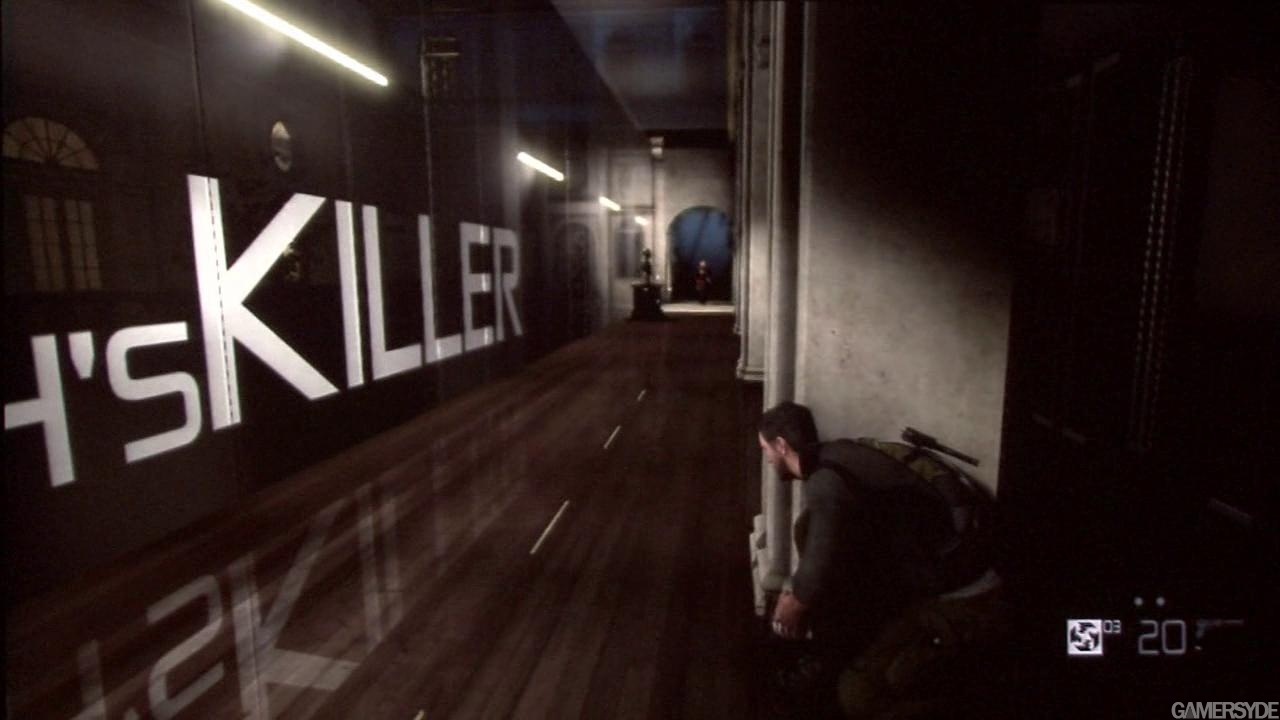
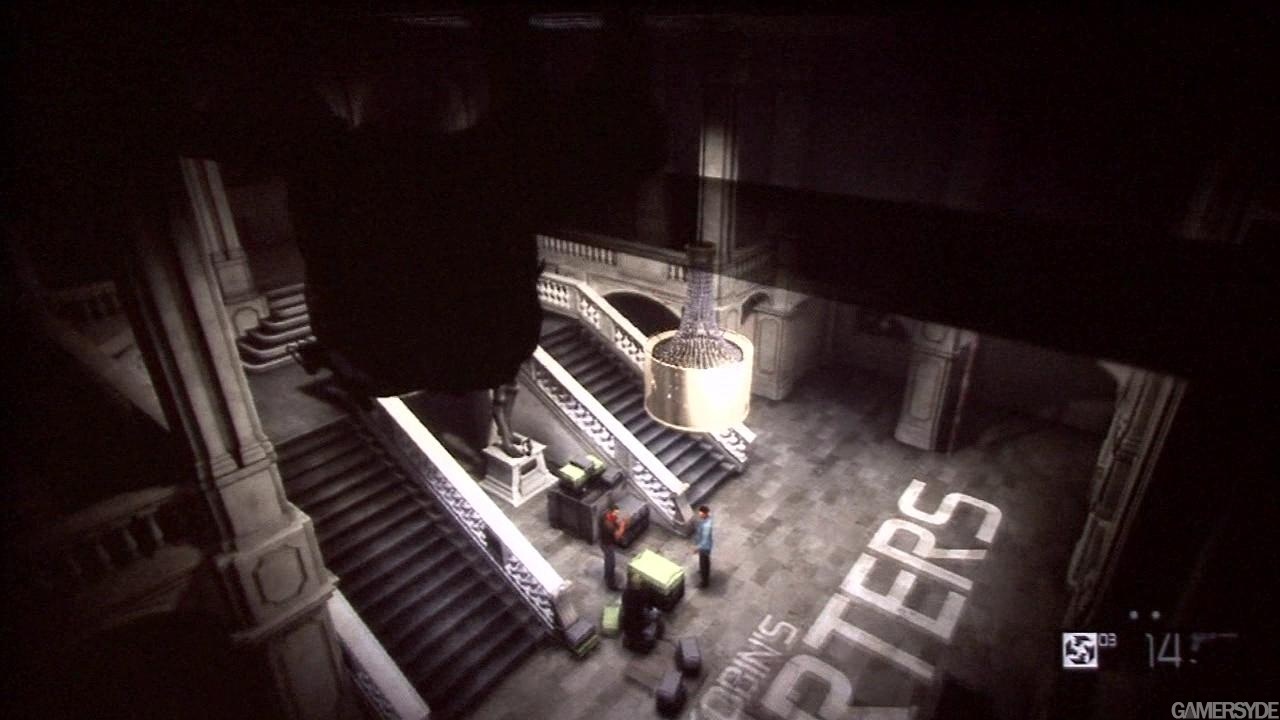
Yet another interesting design choice and quite artsy, with the projector effect breaking the wall between what is diegetic and what is not. I'm not sure if I dig it from an immersion point of view though. Gameplay video can be found at http://www.gamersyde.com/stream_11254_en.html
Update: Interview with the creative director, quite interesting as he, among other things, uses the term "breaking the fourth wall".
Thursday, May 28, 2009
Spatial HUD in Heavy Rain
Upcoming game Heavy Rain features a UI completely freed from a conventional HUD, with occasional button prompts in an overlay manner, yet in the game world as they can be occluded by in-game character models. This information will apparently be harder to see as the character becomes stressed.
 The game also features UI elements presented spatially, not entirely dissimilar to the holograms of the Dead Space UI.
"With a quick movement of the right analog stick we activated his ARI, casting a green hue over the environment. Clicking the right stick sent out a "pulse," revealing evidence – footprints, liquids, airborne particles – invisible to the naked eye. We walked up to tire tracks, pressed a button, and Jayden touched them with his special ARI glove. The system analyzed the tread pattern and confirmed a match to the model of car used by the killer." - Joystiq.com

For a game pursuing immersion as heavily as Heavy Rain, I think the UI design choices are quite interesting. Gameplay video at http://www.gametrailers.com/video/new-character-heavy-rain/49590?r=1
 The game also features UI elements presented spatially, not entirely dissimilar to the holograms of the Dead Space UI.
"With a quick movement of the right analog stick we activated his ARI, casting a green hue over the environment. Clicking the right stick sent out a "pulse," revealing evidence – footprints, liquids, airborne particles – invisible to the naked eye. We walked up to tire tracks, pressed a button, and Jayden touched them with his special ARI glove. The system analyzed the tread pattern and confirmed a match to the model of car used by the killer." - Joystiq.com

For a game pursuing immersion as heavily as Heavy Rain, I think the UI design choices are quite interesting. Gameplay video at http://www.gametrailers.com/video/new-character-heavy-rain/49590?r=1
Wednesday, March 18, 2009
A Semiotic approach to the HUD
This whole thing started with me attempting to do a Wenn diagram explaining Peirce's sign theory. For funnsies I tried to see if it all somehow could be applied to game HUDs. Turns out it can and works very well as a framework for analyzing HUD designs. The diagram brakes up into seven categories (A-G) and I will attempt to give one example from each.

A. Purely iconic signs: Signs that directly depict what they are representing. A photograph is a classic example of an iconic sign. Example: The picture of Atlas in the bottom right corner, Note however that there also exists a indexial relation in this case. Also, the ammo icon in the bottom left directly depicts the kind of ammo equipped.
B. Purely indexical signs - These signs have a direct physical or causal connection to what they signify. Bread crumbs signify bread (Physical) and thunder signify lightning (causal). Almost all sound effects in games are indexical symbols.

 Example: Text instructions in Killzone 2
D. Iconic/indexical signs - both directly depicts what they are symbolizing AND have a casual/ physical connection to something happening in the game.
 Example: Blood stains in Killzone 2 - they directly depicts the blood that the player looses due to being wounded, the amount of blood is related to the amount of damage taken and the direction from where it gushes is related to the direction of the hit.
G. Everything at once! - Maps are a classic example of a sign(system) that occupy all the three groups at once. The map is iconic in that it depicts the actual world (from a top down perspective), it is indexical in that the distances on the map correspond to real world distances according to the maps scale and symbolic in that it often use symbols that need to be interpreted using the maps legend.
 Example: The map in the bottom left corner in GTA4 - The map is an accurate depiction of Liberty City (Iconic), it makes use of a lot of small icons to denote special locations (Symbolic) and it reacts to player actions by constantly rotating and scaling the map (indexical).

A. Purely iconic signs: Signs that directly depict what they are representing. A photograph is a classic example of an iconic sign.
 Example: The picture of Atlas in the bottom right corner, Note however that there also exists a indexial relation in this case. Also, the ammo icon in the bottom left directly depicts the kind of ammo equipped.
B. Purely indexical signs - These signs have a direct physical or causal connection to what they signify. Bread crumbs signify bread (Physical) and thunder signify lightning (causal). Almost all sound effects in games are indexical symbols.

Example: The sound signifying that shield-recharge has started in the Halo series.
C. Purely symbolic signs - All text and abstract signs are symbolic. These signs require that you know some "ground rules" in ordered to be interpreted (Like knowing how to read text or roman numerals).
 Example: Text instructions in Killzone 2
D. Iconic/indexical signs - both directly depicts what they are symbolizing AND have a casual/ physical connection to something happening in the game.
 Example: Blood stains in Killzone 2 - they directly depicts the blood that the player looses due to being wounded, the amount of blood is related to the amount of damage taken and the direction from where it gushes is related to the direction of the hit.
E. Symbolic/iconic signs - A sign that is depicting something, but symbolizing something else or something more general than the symbol suggests. Usually these kinds of signs are widely spread throughout our society. These signs are more abstracted than signs in from category A but still has some connection to their signifies unlike signs from category C.
Examples: A symbol depicting a floppy disk usually means "save" in general, not just "save to a floppy disk".
F. Symbolic/indexical - Thes signs are thing that change in some predetermined manner as an effect of changes in the game world - But still need to be explained to the player, unlike signs from D. Example: All the bars and indicators in Street Fighter 4 - what these bars represent and how they are connected to the actions of the player and the events in the game world is not apparent from the start.
 Example: All the bars and indicators in Street Fighter 4 - what these bars represent and how they are connected to the actions of the player and the events in the game world is not apparent from the start.
G. Everything at once! - Maps are a classic example of a sign(system) that occupy all the three groups at once. The map is iconic in that it depicts the actual world (from a top down perspective), it is indexical in that the distances on the map correspond to real world distances according to the maps scale and symbolic in that it often use symbols that need to be interpreted using the maps legend.
 Example: The map in the bottom left corner in GTA4 - The map is an accurate depiction of Liberty City (Iconic), it makes use of a lot of small icons to denote special locations (Symbolic) and it reacts to player actions by constantly rotating and scaling the map (indexical).
This is useful for analyzing HUD designs form a component level - I belive that for an immersive singe player experience HUD elements should be represented as either A B or D signs. For an engaging and fun multi-player experience however signs from C, E F and G can be used to grate effect.
Thursday, March 12, 2009
Cthulhu: Dark Corners of the Earth
This is footage from CoC:DCOTE - another hudless game. It has some nice hand animations and uses a lot of character dialogue to convey information - Also, the save points are really cool. I intend to play this on PC this weekend in the hope of learning more.
Jurassic Park: Trespasser
Can't help but marvel at how far ahead this game was in many respects.
Check out this video of how they use sound to convey info about the weapons. Read more about the game here. It has many similarities with ME and I think it is worth studying in detail - both the things that worked and the things that don't.
Check out this video of how they use sound to convey info about the weapons. Read more about the game here. It has many similarities with ME and I think it is worth studying in detail - both the things that worked and the things that don't.
Thursday, February 19, 2009
Gaming and Emotions, continued...
In the same study described in the previous post Nicole Lazzaro goes on to compile a list of all the major emotions that player experience when playing video games.
Fear: Threat of harm, object moving quickly to hit player, sudden
fall or loss of support, possibility of pain. Present in most games (Mirror's Edge)
Surprise: Sudden change, briefest of all emotions, does not feel good or bad, after interpreting event this emotion merges into fear, relief, etc. Present in most games - very common in FPS games (Like FEAR or Doom).
Disgust: The strongest triggers are body products such as feces, vomit, urine, mucus, saliva, and blood. Very prominent in games like Dead Space.
Kvell (from Yiddish): Pleasure or pride at the accomplishment of a child or mentee. (Kvell is how it feels to express this pride in one’s child or mentee to others.) - Common in strategy games involving unit management, basebuilding etc or MMO games with elaborate character building.
Fiero (Italian): Personal triumph over adversity. The ultimate Game Emotion. Overcoming difficult obstacles. Players do not need to experience anger prior to success, but it does require effort. Present in all games.
Schadenfreude (German - Sv. Skadeglädje): Gloat over misfortune of a rival. Competitive players enjoy beating each other, especially a long-term rival. Boasts are made about player prowess and ranking. Present in ALL online FPS and MMO games.Tea baging in Halo.
Wonder: Over whelming improbability. Curious items amaze players at their unusualness, unlikelyhood, and improbability without breaking out of the realm of possibilities. Present in open-world games like GTA, Oblivion or World of Warcraft. When first seeing the Chimera fleet over San Fransisco in Resistance 2.
These feeling are, I supose, more relevant to game design in general, but might be somewhat significant to how the UI/menus of a game is designed as well. A Game like Mirror's Edge has heavy elements of Wonder, Fiero, Surprise and Fear an this is to some extent mirrored in the UI design of the game.
Fear: Threat of harm, object moving quickly to hit player, sudden
fall or loss of support, possibility of pain. Present in most games (Mirror's Edge)
Surprise: Sudden change, briefest of all emotions, does not feel good or bad, after interpreting event this emotion merges into fear, relief, etc. Present in most games - very common in FPS games (Like FEAR or Doom).
Disgust: The strongest triggers are body products such as feces, vomit, urine, mucus, saliva, and blood. Very prominent in games like Dead Space.
Kvell (from Yiddish): Pleasure or pride at the accomplishment of a child or mentee. (Kvell is how it feels to express this pride in one’s child or mentee to others.) - Common in strategy games involving unit management, basebuilding etc or MMO games with elaborate character building.
Fiero (Italian): Personal triumph over adversity. The ultimate Game Emotion. Overcoming difficult obstacles. Players do not need to experience anger prior to success, but it does require effort. Present in all games.
Schadenfreude (German - Sv. Skadeglädje): Gloat over misfortune of a rival. Competitive players enjoy beating each other, especially a long-term rival. Boasts are made about player prowess and ranking. Present in ALL online FPS and MMO games.Tea baging in Halo.
Wonder: Over whelming improbability. Curious items amaze players at their unusualness, unlikelyhood, and improbability without breaking out of the realm of possibilities. Present in open-world games like GTA, Oblivion or World of Warcraft. When first seeing the Chimera fleet over San Fransisco in Resistance 2.
These feeling are, I supose, more relevant to game design in general, but might be somewhat significant to how the UI/menus of a game is designed as well. A Game like Mirror's Edge has heavy elements of Wonder, Fiero, Surprise and Fear an this is to some extent mirrored in the UI design of the game.
Why We Play - Gaming and Emotions
According to a study by Nicole Lazzaro (XeoDesign) the reasons why people play video games can be divided into four main "keys" all affecting the focus/design of the game. Any game will include aspects from each key but tend to lean heavily towards one key in particular.
Hard Fun: Players like the opportunities for challenge, strategy, and problem solving. An example of a "hard fun" game would be Civilization.
Easy Fun: Players enjoy intrigue and curiosity. Players become immersed in games when it absorbs their complete attention, or when it takes them on an exciting adventure. An example of an "easy fun" game would be Myst or GTA.
Altered States: Players treasure the enjoyment from their internal experiences in reaction to the visceral, behavior, cognitive, and social properties. These players play for internal sensations such as Excitement or Relief from their thoughts and feelings. An example of an "altered state" game would be Tetris or Halo.
The People Factor: Players use games as mechanisms for social experiences. An example of a"people factor" game would be World of Warcraft.
I think that this way of looking at games can be usefull in that each "key" poses different requirements for the UI. It would be interesting to know what keys are most important to console FPS players - This is something that a focus group might help us with.
Hard Fun: Players like the opportunities for challenge, strategy, and problem solving. An example of a "hard fun" game would be Civilization.
Easy Fun: Players enjoy intrigue and curiosity. Players become immersed in games when it absorbs their complete attention, or when it takes them on an exciting adventure. An example of an "easy fun" game would be Myst or GTA.
Altered States: Players treasure the enjoyment from their internal experiences in reaction to the visceral, behavior, cognitive, and social properties. These players play for internal sensations such as Excitement or Relief from their thoughts and feelings. An example of an "altered state" game would be Tetris or Halo.
The People Factor: Players use games as mechanisms for social experiences. An example of a"people factor" game would be World of Warcraft.
I think that this way of looking at games can be usefull in that each "key" poses different requirements for the UI. It would be interesting to know what keys are most important to console FPS players - This is something that a focus group might help us with.
Monday, February 9, 2009
History of the FPS HUD
“THE STAT-BAR ERA”
Games from this era have a big fat stat bar at the bottom of the screen - serving as the hud
-Look specifically at Doom.
1992: Wolfenstein 3D
1993: DOOM
1995: Dark Forces
1996: Quake
1996: Duke Nukem 3D
“THE MINIMAL HUD ERA”
Games from this era had surprisingly few HUD element compared to other contemporary games - Look specifically at Golden Eye.
1997: Turok (n64)
1997: Golden Eye
1998: Unreal
1998: Thief: The Dark Project
“THE TRANSPARENT OVERLAY ERA”
HUD:s are now displayed as semi-transparent overlays - again becoming more prominent. - Look specifically at Half-Life.
1998: Half-Life
1999: Q3/UT
2001: Halo
2003: Doom 3
2004: Half-life 2
Nowadays we can see a new trend emerging - that of the fully diegetic HUD - first successfully implemented in Metroid Prime (2003).
Games from this era have a big fat stat bar at the bottom of the screen - serving as the hud
-Look specifically at Doom.
1992: Wolfenstein 3D
1993: DOOM
1995: Dark Forces
1996: Quake
1996: Duke Nukem 3D
“THE MINIMAL HUD ERA”
Games from this era had surprisingly few HUD element compared to other contemporary games - Look specifically at Golden Eye.
1997: Turok (n64)
1997: Golden Eye
1998: Unreal
1998: Thief: The Dark Project
“THE TRANSPARENT OVERLAY ERA”
HUD:s are now displayed as semi-transparent overlays - again becoming more prominent. - Look specifically at Half-Life.
1998: Half-Life
1999: Q3/UT
2001: Halo
2003: Doom 3
2004: Half-life 2
Nowadays we can see a new trend emerging - that of the fully diegetic HUD - first successfully implemented in Metroid Prime (2003).
Wednesday, February 4, 2009
Subjective Game Study: Interesting Use of Haptics
The objective game study so far shows that use of rumble as a information channel is very conventional - few games stray outside of the low-level haptic feedback indicating firing a weapon or getting hit by fire. The only games included in the study that use rumble to convey slightly more sophisticated information are Turok, indicating that the bow is strained to the max level, and Conflict: Denied Ops, providing vibrations in pace with a bomb countdown.
The games that contain interesting and in my opinion noteworthy uses of rumble that we've found so far, resides in other genres.
As far as location-bound information is concerned, Ocarina of Time and Maximo vs Army of Zin both uses vibrations to indicate that the player is, respectively, above or near a hidden treasure. There's also a Xbox Live community game named In the Pit entirely without graphics, using rumble to convey where enemies are in relation to the player.
Another take on spatial information is Rockstar's Table Tennis, using rumble to give the player a feeling of how close to the edge of the table that the ball will end up (more intense vibrations = closer to the edge of the table).
Silent Hill uses heart beat-paced vibrations to convey level of health.
There's also some more experimental uses of controller haptics, such as the boss Psycho Mantis in Metal Gear Solid demonstrating his psychic abilities in a cut-scene by vibrations, or the Rez trance vibrator add-on.
The games that contain interesting and in my opinion noteworthy uses of rumble that we've found so far, resides in other genres.
As far as location-bound information is concerned, Ocarina of Time and Maximo vs Army of Zin both uses vibrations to indicate that the player is, respectively, above or near a hidden treasure. There's also a Xbox Live community game named In the Pit entirely without graphics, using rumble to convey where enemies are in relation to the player.
Another take on spatial information is Rockstar's Table Tennis, using rumble to give the player a feeling of how close to the edge of the table that the ball will end up (more intense vibrations = closer to the edge of the table).
Silent Hill uses heart beat-paced vibrations to convey level of health.
There's also some more experimental uses of controller haptics, such as the boss Psycho Mantis in Metal Gear Solid demonstrating his psychic abilities in a cut-scene by vibrations, or the Rez trance vibrator add-on.
Tuesday, February 3, 2009
Subjective study: Games worth checking out
Here are some games I think we should include in our subjective study concerning "HUDlessness".
Jurassic Park: Trespasser - One of the first attempts at a HUDless FPS, with a lot of great ideas still unseen since its release in 1998.
Call of Cthulhu: DCotE and Peter Jackson's: King Kong - More recent attempts at making HUDless or near HUDless FPS games.
Resident Evil: Code Veronica (DC) - Besides from being HUDless the Dreamcast version of RE:CV had the interesting feature that you could see an EKG (health indicator) on the games "controller screen" (VMU).
ICO - HUDless and with lots of interesting "states" indicated by sound and graphical signifiers.
Dead Space and Alone in the Dark: Inferno - for their use of diegetic menues.
Metroid Prime - For its use of a diegetic HUD
Condemd - For how it handles 1st person melee and "forensic" sceenes.
Jurassic Park: Trespasser - One of the first attempts at a HUDless FPS, with a lot of great ideas still unseen since its release in 1998.
Call of Cthulhu: DCotE and Peter Jackson's: King Kong - More recent attempts at making HUDless or near HUDless FPS games.
Resident Evil: Code Veronica (DC) - Besides from being HUDless the Dreamcast version of RE:CV had the interesting feature that you could see an EKG (health indicator) on the games "controller screen" (VMU).
ICO - HUDless and with lots of interesting "states" indicated by sound and graphical signifiers.
Dead Space and Alone in the Dark: Inferno - for their use of diegetic menues.
Metroid Prime - For its use of a diegetic HUD
Condemd - For how it handles 1st person melee and "forensic" sceenes.
Wednesday, January 14, 2009
Upcoming HUD-free game: Afro Samurai
Upcoming game Afro Samurai will be "entirely HUD-free", enforcing "a few elegant touches like this - enemies' health showing in how bloody their clothes are", according to Eurogamer:
http://www.eurogamer.net/articles/afro-samurai-hands-on
http://www.eurogamer.net/articles/afro-samurai-hands-on
List of HUDless games
The following is a link to a list of HUDless or near HUDless games that might be worth checking out in detail.
http://www.mobygames.com/game-group/hudless-games/offset,0/so,1d/
http://www.mobygames.com/game-group/hudless-games/offset,0/so,1d/
Subscribe to:
Posts (Atom)